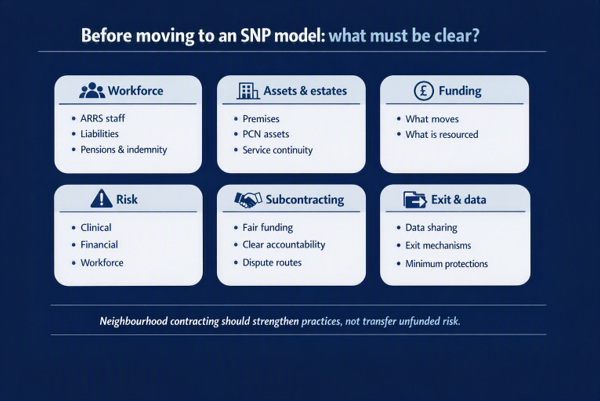
Across England, systems working on neighbourhood models, population health and out-of-hospital redesign are experiencing a familiar frustration. National momentum has slowed, guidance has yet to land, and key contractual frameworks remain unresolved. As a result, local leaders are being asked to make decisions without clarity on how those choices will align with national expectations.
While the ambition for neighbourhood working and a continued shift towards prevention remains intact, the policy environment has entered a period of hiatus. Understanding what is driving the delay — and how local organisations can still make progress — is critical for PCNs, local authorities, collaboratives and neighbourhood teams attempting to move forward in conditions of uncertainty.
1. The Guidance Gap: What’s Driving the Delay?
Several interlocking factors are contributing to the current slowdown at the centre.
Contractual uncertainty across general practice and PCNs
Key national contracts, including the GP contract, the PCN DES and emerging neighbourhood frameworks, have not yet been finalised. With implementation timelines approaching, many leaders are understandably cautious about committing to structural or workforce changes that may later conflict with national requirements.
Ongoing realignment between NHS England and the Department of Health
Although NHS England is formally being absorbed into the Department of Health, in practice the integration of people, priorities and operating models remains complex. This has slowed decision-making, as ambitions for neighbourhood working must be reconciled with existing levers, governance arrangements and constrained budgets.
The unresolved question of funding
Perhaps most significantly, neighbourhood working still lacks a clearly defined funding stream. Current thinking appears to focus on repurposing existing budgets — particularly PCN funding, elements of the Better Care Fund and the much anticipated “left shift”— but without clear decisions, progress has stalled. Until funding routes are more explicit, progress at the national level is likely to remain cautious.
2. The Impact on Local Systems — and Why It Matters Now
While national clarity is delayed, pressure on local systems has not diminished. The guidance is already shaping behaviour and creating challenges on the ground.
Neighbourhood development continues, but without formal levers
In many areas, neighbourhoods are continuing to develop through local initiative, partnership building and pragmatic problem-solving. However, progress is often reliant on relationships rather than contractual authority, making change harder to sustain or scale.
Local authorities are increasingly central to neighbourhood planning
Health and Wellbeing Boards have been given formal responsibility for neighbourhood plans. For some areas, this represents a significant cultural shift, particularly where neighbourhood working has not historically been a core focus. Capacity, confidence and clarity vary widely.
Gaps in population health data limit effective planning
In the absence of strong population health management tools, systems struggle to differentiate need at neighbourhood level or to make a compelling case for resource reallocation. This creates a bottleneck for strategic planning and service redesign.
Community services are not aligned to neighbourhood footprints
Many community provider contracts remain organised around legacy geographies rather than neighbourhoods. Workforce shortages compound the challenge, making it difficult to reshape services quickly even where the will exists.
3. What Can Organisations Do During the Hiatus?
Despite the uncertainty, there are clear actions that organisations can take now to prepare for what comes next.
Strengthen and realign the ARRS workforce
PCNs can use this period to review how ARRS staff are deployed, ensuring roles are effective, sustainable and aligned with future neighbourhood models. This includes making deliberate choices about which functions should remain attached to the original intention of adding much needed capacity to core general practice, and which may eventually sit at neighbourhood level.
Address governance issues early
Many of the governance challenges associated with neighbourhood working, such as complaints handling, shared accountability and joint decision-making, will exist regardless of the final contractual framework. Tackling these issues now reduces future friction and builds confidence between partners.
Use local collaboratives to address pathway challenges
Some of the most pressing issues facing systems, such as long waits or fragmented pathways, cannot be solved through structural redesign alone. Local collaboratives that bring together PCNs, neighbourhood teams, community services and acute providers can begin redesigning care models now, ahead of formal mandates and without more traditional commissioning approaches.
Prepare for likely sequencing of national contracts
Current signals suggest that any future neighbourhood contract is likely to emerge first at a single-neighbourhood footprint, with multi-neighbourhood arrangements following later. Systems that focus initial preparation at this level are likely to be better positioned to respond quickly when guidance arrives.
Periods of policy uncertainty are uncomfortable, but they also create space for locally driven progress. Systems that continue to build relationships, clarify governance and strengthen neighbourhood capability now will be best placed to capitalise when national direction finally catches up.