After yet another stint with Radio 4, I found myself grumbling about GIRFT and marvelling at the genius of those who repackage 1970s quality control as ground-breaking in the public sector. There’s probably a special place in management heaven for them. Have a read and let me know: should I just stick to lighter listening, or get out more?
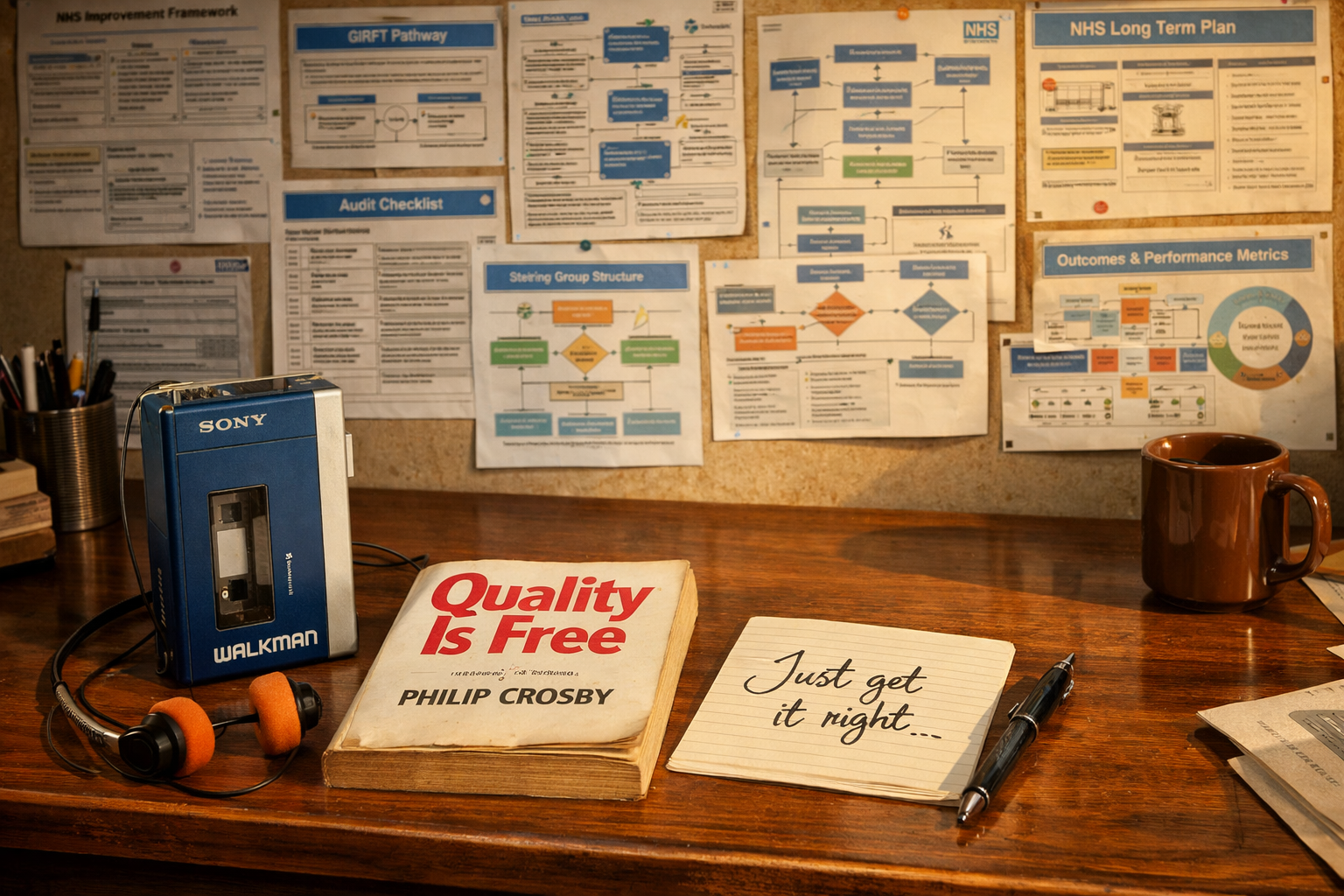
Right First Time (RFT) emerged during the heyday of quality management, when Philip Crosby declared “quality is free” and zero defects weren’t just possible—they were cheaper. This was 1979: Sony had just released the Walkman, Thatcher had claimed Downing Street, and somewhere in the Midlands, a manager had an epiphany: what if we just didn’t make mistakes?
Fast-forward to 2026, and we’re drowning in “First Contact Resolution,” “Getting It Right First Time programmes” (with capital letters and a steering group), “Zero Harm pathways,” and my new favourite, “Optimised Single-Touch Processing.” All are elaborate ways of saying: do your job properly the first time so no one has to do it again.
The NHS is especially keen on reviving RFT, rolling out initiatives to cut emergency readmissions, eliminate avoidable harm, and improve care handovers (don’t lose the notes). Each comes with its own toolkit, acronym, and framework, but boils down to: just get it right in the first place.
Local government, on the other hand, has quietly practised RFT out of necessity since 2010. When your budget’s slashed by 40%, you soon realise you can’t process the same housing form three times. Austerity teaches RFT whether or not you publish a paper about it. Or write a book about Austerity as I did.
The irony? Crosby’s original idea was anti-bureaucratic: quality inspection and rework cost more than prevention. Do it right once and you don’t need all those checking and fixing layers.
Yet somehow, we’ve built whole industries around ensuring things are done right first time—frameworks, audits, training, all to support a concept meant to eliminate the need for such scaffolding.
There’s something gloriously daft about a change programme to persuade professionals to try getting things right instead of wrong. It’s the workplace equivalent of a “Don’t Forget to Breathe” app—possibly useful, definitely troubling.
The real magic of RFT is its simplicity. Forget frameworks. What’s needed is competent people, enough resources, clear processes, and the time to do things properly. Tackle the root causes, not just the symptoms.
It all loops back to Crosby: quality is free if you invest properly at the start. Getting it right first time ultimately costs less than repeated fixes. It’s not revolutionary, or even very clever—it’s just true. And it was already true in 1979.
Sometimes, the old tunes really are the best.