At Scale works across a wide range of organisations involved in health and wellbeing, including NHS providers, primary care networks, GP federations, local authorities and voluntary sector organisations. That cross-sector perspective gives us a useful vantage point when major structural shifts begin to emerge within the NHS.

One of the things we increasingly notice is that different parts of the system often hear about important policy developments at very different times. Large NHS organisations may be close to the conversation early on, while partners in primary care, local government or the voluntary sector may only encounter the implications much later, sometimes when the changes have already begun quietly taking shape.
For that reason, we have produced this as a longer read article.
The concept of Advanced Foundation Trusts is beginning to appear more frequently in national policy discussions. At first glance it may look like an internal NHS governance development, something primarily relevant to trust boards, regulators and people who enjoy reading consultation documents for recreation. In reality, it may signal a much broader shift in how services are organised and coordinated across local health and care systems.
Even if these changes take time to affect your organisation directly, it is important to understand the ideas emerging around you. Leaders who recognise the direction of travel early are far better placed to position their organisations effectively as systems evolve. Across the NHS, many organisations are currently waiting for clearer national guidance about what the next phase of reform will look like. That is understandable. Policy language evolves quickly and the practical implications for local systems are not always immediately obvious.
However, waiting patiently for the next national instruction has rarely been a winning strategy in the NHS. By the time detailed guidance arrives, the organisations that have already begun thinking differently about their future role are often the ones shaping the agenda rather than reacting to it.
Advanced Foundation Trusts (AFT)
The emerging Advanced Foundation Trust (AFT) model is a good example. What appears to be a technical governance development may in fact represent an important step in how the NHS intends to organise leadership, integration and service delivery in the future. A reinvention of the original foundation trust idea? The AFT concept sits within the NHS’s wider reform direction, including the now familiar three shifts in health policy: moving care from hospital to community, from analogue to digital, and from sickness to prevention. In policy terms, the model is described as a “reinvigorated and reinvented foundation trust model.” If that phrase sounds slightly familiar, it should. The original foundation trust reforms two decades ago were also designed to give strong organisations greater autonomy and freedom to innovate. The difference this time is that the NHS is trying to apply that idea within a much more integrated system landscape.
In practical terms, AFTs are expected to demonstrate strong leadership and governance, consistently high-quality care, financial sustainability, the ability to work collaboratively across systems, and capability to support neighbourhood and population health models. Organisations that achieve AFT status would enjoy greater operational and financial flexibility and would experience a lighter-touch regulatory relationship with NHS England. In other words, they would operate less as tightly supervised providers and more as trusted system leaders.
First Wave AFTs
The first wave tells an interesting story. In November 2025 the Secretary of State announced the eight organisations selected for the first wave of Advanced Foundation Trust assessment: Berkshire Healthcare NHS Foundation Trust, Dorset Healthcare University NHS Foundation Trust, Central London Community Healthcare NHS Trust, Northamptonshire Healthcare NHS Foundation Trust, Northumbria Healthcare NHS Foundation Trust, Alder Hey Children’s NHS Foundation Trust, Norfolk Community Health and Care NHS Trust, and Cambridgeshire Community Services NHS Trust.
These organisations were selected because they demonstrate strong performance across quality, leadership and financial stability. However, the most interesting aspect of the list is the type of organisation represented. The first wave is not dominated by the largest acute hospital trusts. Instead, it includes a strong presence of community, integrated and specialist providers. That pattern is unlikely to be accidental.
The NHS is increasingly focused on delivering care closer to communities and strengthening neighbourhood health models. Acute hospitals remain critical to the system, but they are also dealing with a range of operational pressures that make large-scale system redesign slightly harder to prioritise. Emergency demand, elective recovery and workforce pressures tend to focus attention quite effectively on the here and now. Community and integrated providers, by contrast, often work across a broader mix of services including community health services, mental health, children’s services, prevention and outreach programmes, and partnerships with primary care and voluntary organisations. Because of this, they are often closer to the kind of cross-sector working that neighbourhood health models require. The first wave of AFT candidates therefore appears to be testing whether organisations already comfortable operating across organisational boundaries can become the delivery anchors of future health systems.
No Longer Entitled – Earn Your Autonomy!
One important feature of the new model is that AFT status is not intended to be permanent or automatic. Organisations will be assessed against leadership, quality, collaboration and financial sustainability. Status can be reassessed periodically and potentially removed if standards decline. This represents a shift towards earned autonomy. High-performing organisations are given greater freedom to lead, but they are also expected to demonstrate consistently that they can operate at that level.
Alongside the AFT programme sits another important concept, the Integrated Health Organisation (IHO). This model explores whether certain high-performing providers could take responsibility for managing health budgets for defined populations. In this scenario, an organisation would coordinate services across a network of partners rather than delivering everything itself. That network could include GP practices and PCNs, community services, mental health providers, voluntary and community sector organisations, and prevention and wellbeing initiatives. The focus would shift from managing individual services to improving population health outcomes.
Two of the first-wave trusts, Northamptonshire Healthcare NHS Foundation Trust and Northumbria Healthcare NHS Foundation Trust, are expected to undergo additional assessment as potential early candidates for the IHO model. If this approach develops further, it could represent one of the most significant structural changes in NHS delivery for many years.
Meaning What?
For organisations outside large trusts, the emergence of AFTs and potential IHOs raises important strategic questions. Historically, service design in the NHS has largely been led by commissioners, with providers responding to specifications and contracts. If the AFT/IHO models develop as intended, the balance may begin to shift towards provider-led coordination of delivery, with large capable organisations acting as integrators for local systems.
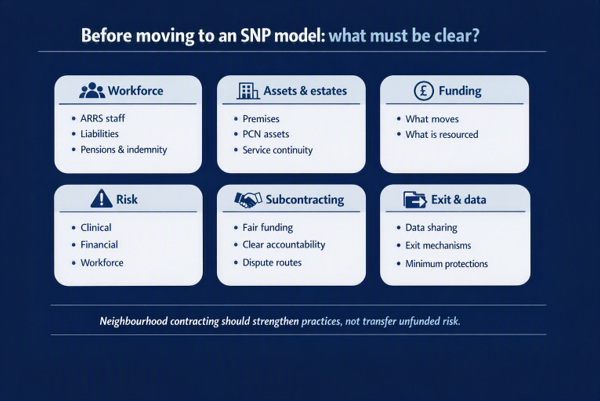
This creates both opportunities and risks. The opportunity is that stronger integrator organisations could help coordinate complex partnerships more effectively, supporting genuine collaboration across sectors. The risk is that smaller organisations may find themselves positioned primarily as subcontractors rather than strategic partners unless they can demonstrate clear delivery capability and system value.
Should I Just Wait, and See?
For leaders in primary care, community services and voluntary sector organisations, the key point is this. The NHS landscape is evolving, but the direction of travel is becoming clearer. Systems are moving towards larger scale collaboration, neighbourhood health delivery and population-based thinking. Organisations that begin positioning themselves within that landscape now will have a stronger voice in shaping how it develops locally. Those that wait patiently for the final national blueprint may discover that important structural decisions have already been made.
While AFTs and IHOs are still a developing policy idea and further guidance is expected. However, the direction of travel suggests a future NHS in which some organisations act as trusted system leaders, coordinating care across networks of partners and focusing on population outcomes rather than organisational boundaries. For local leaders, the important question is not simply whether their organisation could ever become an AFT. The more relevant question is: what role will our organisation play in the emerging delivery architecture around them?
Those who begin exploring that question now will be much better prepared for the next phase of NHS reform. And if there is one lesson the NHS has taught over the years, it is this. The future rarely arrives all at once. But it does tend to arrive slightly earlier for the organisations paying attention.
If this post resonates, perhaps it is time for a different conversation. Message me on LinkedIn, email mike.gill@atscale.co.uk, or visit www.atscale.co.uk to see how we support clients working at scale where you can download this long read on PDF.