Put a well-run multi-service business alongside an NHS neighbourhood and they look like different species.
One has customers, a chief executive, employees and a board. The other has patients and communities, a Head of Neighbourhood, independent partners and more organisational logos than a conference lanyard.
Look beyond the labels, though, and the similarities are striking.
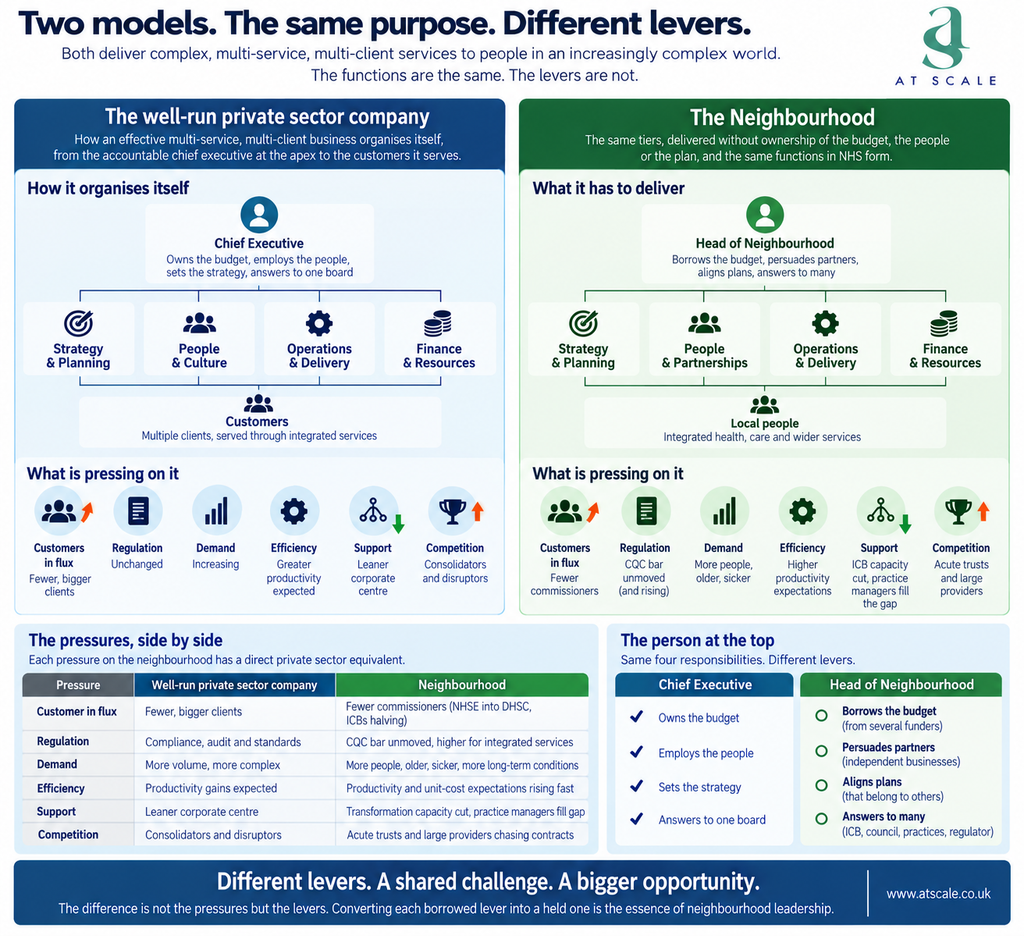
Both are expected to improve outcomes, manage resources, coordinate multiple services and respond to changing demand. Both serve large populations through increasingly complex delivery models. Both must find ways to improve productivity while maintaining quality. The functions are remarkably similar. The pressures are often similar too.
Demand is becoming more complex
Businesses face customers wanting more services, faster responses and better experiences. Neighbourhoods face populations that are older, living longer and increasingly managing multiple long-term conditions. Different pressures on paper. Similar challenges in practice.
Productivity is non-negotiable
Businesses face margin pressure. The NHS talks about productivity, value and unit cost. Either way, leaders are confronting the same uncomfortable question: how do we deliver more with finite resources?
The customer base is changing
Many sectors have seen consolidation, leaving organisations serving fewer but larger clients. Neighbourhoods are seeing something similar as ICBs continue to rationalise and NHS England functions move into DHSC. Commissioners are becoming larger, expectations are increasing and competition for influence is intensifying.
Support is thinning
Most private-sector organisations have spent years reducing corporate overheads. Neighbourhoods are living through a similar shift. ICB running-cost reductions are removing system capacity and expertise, with local leaders and practice managers increasingly stepping in to fill the gap.
Influence matters more than hierarchy
This is perhaps the most important difference. A chief executive can usually rely on organisational authority. A neighbourhood leader often cannot. Most partners work for somebody else, hold a different budget, answer to a different board and operate under different priorities. Progress depends less on organisational hierarchy and more on trust, credibility, relationships and shared purpose.
Neighbourhood leadership is therefore not simply about managing services. It is about aligning organisations that were never designed to be led together. That creates an unusual paradox.
Neighbourhood leaders are increasingly expected to do many of the things a chief executive does: improve outcomes, steward resources, coordinate delivery, manage performance and lead change. Yet they rarely own the budget, employ the workforce or direct the organisations involved.
The responsibilities increasingly resemble those of a chief executive. The authority does not.
That is not a weakness. It is a different leadership discipline altogether.
Next time: Same responsibilities. Different levers.
What sort of leader does a neighbourhood need?
If you are leading, or preparing to lead, a neighbourhood, this challenge is becoming increasingly real. Many neighbourhood leaders find themselves carrying responsibilities that look remarkably similar to those of a chief executive, but within very different organisational conditions.
At Scale works with emerging and established neighbourhood leaders to build the leadership, governance and operating models needed to thrive in this environment.
Want to explore what this means for your own leadership journey? Contact At Scale at mike.gill@atscale.co.uk or visit atscale.co.uk.