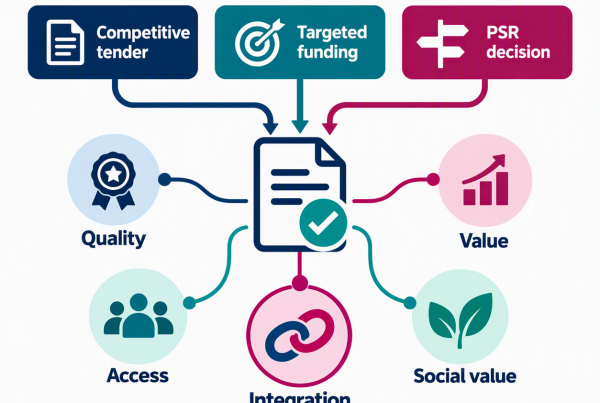
After a couple of weeks to reflect on NHS England’s consultation, my thoughts have started to crystallise. The proposed Multi-Neighbourhood Provider and Single Neighbourhood Provider contracting models may sound technical, but their implications for general practice are very practical. At their best, these proposals could support more integrated neighbourhood health services, bring care closer to home and create clearer routes for commissioning services around local populations. The ambition is right: patients need services that feel joined up, proactive and easier to navigate.
For practices, PCNs and GP-led organisations, the key question is not whether neighbourhood working matters. It clearly does. The question is whether the proposed contracting routes will strengthen general practice as a core partner in neighbourhood care, or whether they risk creating another layer of complexity, accountability and workload above already pressured teams.
The reassurance: core GP contracts are not directly in scope
One important point is that the consultation does not propose changes to core GMS, PMS or APMS contracts. Core general practice remains outside the direct scope of these new models. That reassurance matters and should not be lost in the wider debate.
However, the proposals could still affect the wider operating environment around practices. Enhanced primary medical services, PCN DES-type functions, urgent primary care, medicines optimisation, neighbourhood transformation support and general practice resilience could all potentially sit within or alongside Multi-Neighbourhood Provider and Single Neighbourhood Provider arrangements. That means the detail matters.
The opportunity: GP-led neighbourhood working at scale
Done well, these models could give general practice and GP-led organisations a stronger platform to influence wider pathways, coordinate services across neighbourhoods and secure more stable multi-year arrangements. They could support the shift towards prevention, proactive care and integrated teams working around the needs of defined populations.
There is also a real opportunity for federations, PCN companies and other primary care organisations to play a leading role. Many have the relationships, practical delivery experience and local insight needed to make neighbourhood working meaningful. The consultation should therefore be seen not only as a risk to manage, but as a chance for general practice to shape the rules before they are fixed.
The risk: integration without sufficient practice voice
The biggest risk is that integration becomes something done to general practice rather than with it. If Multi-Neighbourhood Provider contracts are held by larger providers without strong safeguards, practices could find themselves carrying delivery responsibility through subcontracting arrangements while having limited control over funding, workforce, service design, data sharing or clinical risk.
This is why practice consent, voting rights and governance representation are essential. General practice should not be reduced to a delivery arm within someone else’s neighbourhood model. It must be an equal strategic partner, with clear rights and responsibilities from the outset.
The practical issues that need clarity
Before any system moves from PCN DES arrangements to a Single Neighbourhood Provider model, practices will need clear answers on ARRS staff, employment liabilities, pensions, indemnity, estates, existing PCN assets and continuity of services. They will also need transparency on which funding streams are being moved into new contracts and whether any additional workload is genuinely resourced.
Subcontracting arrangements will also need nationally defined minimum protections. Practices should not be expected to take on additional clinical, financial or workforce risk without fair funding, clear accountability, robust data-sharing arrangements, dispute routes and exit mechanisms. Without this, neighbourhood contracting could unintentionally destabilise the very practices it is meant to support.
What could be said in response
A constructive response can support the ambition for more integrated, population-based neighbourhood care while being firm about the conditions needed for success. General practice should ask for explicit safeguards on practice voice, funding transparency, proportional procurement, clinical governance, safe subcontracting and protection from unfunded workload transfer.
It should also press for GP-led organisations to have a fair opportunity to hold or participate in these contracts. Procurement processes must be proportionate and accessible, otherwise there is a risk that larger incumbent providers are better positioned than the primary care organisations closest to patients and practices.
My view
Neighbourhood working will only succeed if it is built on the strengths of general practice: registered list relationships, trusted local knowledge, continuity, population insight and practical delivery experience. These proposals could help unlock better integrated care, but only if practices are genuinely involved in shaping, governing and delivering the model.
General practice should therefore engage actively with the consultation. The response should be constructive, but it should also be clear: integration must strengthen primary care, not sideline it. The final contracting models need to protect practice sustainability, support GP-led collaboration and ensure that neighbourhood care is genuinely designed around patients, communities and the teams who know them best.